Saturday, October 10, 2009

LEED Buildings: How energy efficient are they??

So far in my career, I have been exposed to a few decent examples of the "way things really work" in the building industry. I've learned that building energy simulations and early design analysis can be tweaked to produce figures which will please the client all while staying within commonly accepted assumption boundaries. I've learned how and why the ignorance regarding the actual science behind green buildings is exploited as everybody rushes to jump on the bandwagon. And now, after stumbling upon the website created by a veteran in the building energy efficiency industry, Henry Gifford, I've begun to take a more critical look at my once flawless view of the LEED Rating System.

LEED is almost a household term these days after the US Green Building Council established it as the pioneering method for benchmarking the performance of buildings which fit the characteristics of good energy and environmental design. LEED has truly been a very successful program; the environmentally-conscious education of literally thousands of building industry professionals and construction of millions of square feet of new buildings has been guided by its good intentions. But now, it is becoming more evident that good intentions and solid marketing value of LEED is not enough to actually make a significant impact on the energy consumption of buildings.

A 2008 study that was prepared by the New Buildings Institute with funding from the USGBC and the EPA shows that the median of the 121 LEED Buildings tested perform at 24% better than than the national mean of US Building stock. Sounds great, right? Well, a more critical look by Mr. Gifford exposed flaws in the way the data was presented which shows actually that LEED buildings perform worse when the mean of their values of consumption is compared to the mean of the recently constructed building stock (2000-2003).  The "gist" of this contradicting study can be found from Henry's presentation at the Westford Symposium for Building Science:


This must be embarassing for the USGBC - however they need to stop getting defensive about it and take it as a call to action to make the system more legitimate! I think in many ways this is occuring based on a press release sent out to USGBC members on Sept 25. In it they say that they are "Tackling Building Performance Head On!!". This sounds very hopeful in my opinion however it must be done right in order to be effective. The building owner and maintenance personnel must truly be held accountable for the energy performance of the building and as Henry eloquently states "the plaque should be attached with removable screws".

A very thorough paper outlining Gifford's approach to rating buildings can be found here.

Monday, September 21, 2009

Sun? Wind? No! We need Conservation and Efficiency!!

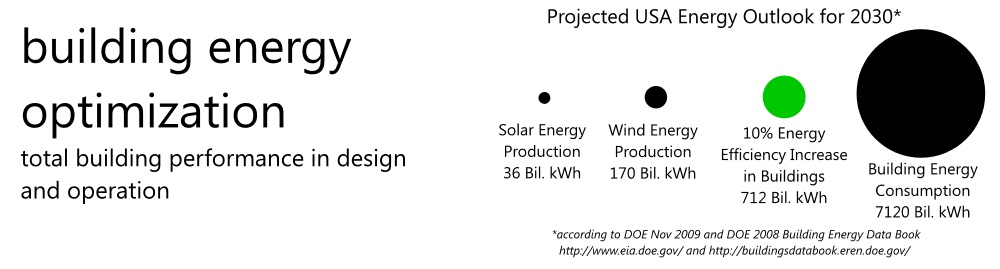
Just this last week, I had the opportunity to attend the Asian Youth Energy Summit at the National University of Singapore. There were many very riveting speakers at this event including a number of solar, wind, biofuels (from algae even!) and other various types of renewable energy proponents. However, one thing that struck me as odd and even frightening was the virtually complete lack of discussion about the DEMAND side of the energy issue. I believe that everyone left the event believing that solar and wind power is going to save the human race... the issue that we face is that for every wind turbine that is put up in the world - there are hundreds of poorly constructed buildings that will excessively consume the clean energy produced and then some.

This issue has prompted me to change my banner to reflect a few simple statistics that I quickly found in the Building Energy Data Book and the Dept of Energy's Energy Information Administration (simply two of the greatest sources of world energy statistics). One can see the scale by which the PROJECTED energy production and consumption differ with regards to the two most touted renewable energy schemes as compared to the actual building energy consumption. I have no beef with the sun and wind people - I just think that we're hyping that portion of the solution up way too much.

How can we bring conservation and efficiency to the forefront of the energy debate?! How can we make it as "sexy" as solar panels and wind turbines? How can we actually achieve a 5-10% energy efficiency reduction for the 2030 building energy predictions? And how do we get designers and owners to value ACTUAL energy savings as opposed to just those on paper or in a simulation program?

I have some ideas. I'm sure you have some ideas. Let's figure it out!!

Below I've created a few simple graphs giving some breakdowns of the supply vs demand comparisons:


Wednesday, August 19, 2009

Opportunity

Thus begins my first attempt at a pseudo-professional blog to cover my passion for innovations in the built environment. I'm not really sure if anyone will ever read it or take much stock in the sarcastic and possibly overzealous manner in which it is presented but that doesn't bother me any. I am here to get my ideas/interests/discoveries down so that future generations can see proof of my blind, youthful optimism of improvements in the building industry when I become an old cynical mechanical engineer. Without further ado I will dive into the reason that I'm so optimistic about changes in the building industry - the following headline was taken from a source reporting a market research discovery by McGraw Hill:

$60 Billion to be spent on Green Buildings

"$12 Billion was spent on Green Buildings in 2008. This number is projected to grow to $60 Billion by 2013.”
-McGraw-Hill Construction, SmartMarket Trends Report, 2008

You'll find that my rants will follow along the opportunities and what this growth will provide. However you'll also get a few doses of skepticism regarding some of the "green technologies" which this capital will go towards as well.


Who am I?

My photo
I'm a building energy engineer spending the year on a Fulbright Grant in Singapore. My focus in is building energy optimization and HVAC technologies. This is not an official Dept of State website or blog. The views and information presented does not represent the Fulbright Program or the US Dept of State.

Followers